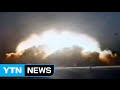
The footage the South Korean TV channel used is actually video of a Soviet hydrogen bomb testing in 1953

South Korean Media Uses Soviet Footage of Hydrogen Bomb.
Gazeta.ru
Over 60-years ago the Soviet Union tested its first hydrogen bomb RDS-6 at the Semipalatinsk test site in Northern Kazakhstan.
North Korea Confirms Successful Testing of Hydrogen Bomb
Earlier
in the yesterday, South Korean media reported that a strong earthquake
occurred in North Korea near Phungeri nuclear test site in Yangkang
Province. Subsequently, North Korea confirmed in an official statement
it had successfully tested a hydrogen bomb.
North Korea declared itself a nuclear power in 2005 and conducted a
series of underground nuclear weapon tests in 2006, 2009 and 2013.
Pyongyang's nuclear program has caused deep concern of the international
community and prompted the UN Security Council to slap a series
of sanctions against the country.
North Korea has announced that it has
successfully tested a miniaturized hydrogen bomb following an “artificial seismic event” that
has likely become the country’s fourth known nuclear test.
In a “special and important” announcement at noon, North Korean TV
claimed that the country has successfully conducted a hydrogen bomb test
at 10:00am local time yesterday.
“Through the test conducted with indigenous wisdom, technology and
efforts the DPRK fully proved that the technological specifications of
the newly developed H-bomb for the purpose of [the] test were accurate
and scientifically verified the power of [the] smaller H-bomb,” the
statement said.
“It was confirmed that the H-bomb test conducted in a safe and
perfect manner had no adverse impact on the ecological environment,” it
added.
The announcement followed the USGS detection of a 5.1 magnitude earthquake in the vicinity of a known Pyongyang nuclear site.
The epicenter of the jolt was located 19 kilometers (12 miles)
east-northeast of Sungjibaegam, Ryanggang Province, at a depth of 10
kilometers, according to preliminary data from the US Geological Survey
(USGS).
Similar seismic activity in roughly the same area was recorded
on February 12, 2013, prior to North Korea claiming its third successful
underground nuclear test.
The “unusual” seismic activity near a “known” North Korean nuclear
site seems to be of artificial origin and was a clear sign of a nuclear
test, Yonhap reported.
“The Foreign Ministry is currently holding a meeting presided over by
the minister to immediately determine the situation following the
reports,” a ministry official said, according to the South Korean news
agency.
South Korea’s intelligence agency is analyzing the probability of a
fourth nuclear test having taken place, while the National Security
Council is preparing to hold a meeting to discuss the issue, Yonhap
reported.
Japan’s chief government spokesman also said the earthquake was
“likely caused” by a nuclear test, Reuters reports. Meanwhile a US
defense official said the department was “looking into the reports of a
possible seismic event near North Korean nuclear facilities.”
North Korea first declared that it created a nuclear bomb in 2005.
Since then, Pyongyang has conducted three known underground tests. The
first, conducted in 2006 at the Punggye-ri Nuclear Test Site in the
northeast of the country, contained five to 10 kilotons of explosives.
It was recorded by seismic stations in Russia, China, Japan, South Korea
and Australia.
The second and third tests were conducted in May 2009 and January
2013, increasing the power of the devices tested 10 to 20 kilotons of
TNT each.
North Korea’s 2013 test triggered sanctions from the UN Security
Council, which put restrictions on the county’s banking, trade and
travel immediately.
Pyongyang also operates a nuclear reactor at the Yongbyon Nuclear
Scientific Research Center, North Korea’s major nuclear facility, about
90 kilometers from the capital.
North Korea has repeatedly threatened the use its nuclear weapons in
case of a violation of its sovereignty. Last month Pyongyang claimed
that it had become a “great nuclear power capable of defending the
independence and national dignity of our homeland by mighty nuclear and
hydrogen strikes.”
However, it is not known whether North Korea had managed to develop a
nuclear device small enough to be used as a warhead on a ballistic
missile.