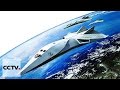
China is developing a perspective hybrid reusable space vehicle that will combine three different kinds of engine technologies, reported
CCTV.Namely, the new ship that is being developed as a “combination powered aircraft” will rely on an indigenous turbine, ramjet and rocket engines to power the spaceship in different phases of the flight into space. Such technology, China hopes will make orbit traveling that will span between dozens to hundreds of kilometers from the Earth much cheaper.
The idea envisions that the combination of engines will allow the aircraft to take off like an airplane and land at an airport facility, saving costs by getting rid of the expenses associated with the space launch facility.
Scientists believe that they are capable of producing an aircraft that will take off at low speed using a high-performance aviation turbine engine or air-breathing rocket engine. After reaching a certain speed, supersonic combustion ramjet engine will kick allowing the vehicle to reach the upper atmosphere where the rocket engine will be used to break through Earth’s gravity.
“We have made a long-term plan of taking about three to five years to master the key technologies, and significantly improve the capability of the spacecraft during the application,” said Zhang Yong, China Aerospace Science & Technology Corp, as quoted by Xinhua. “We aim to implement the technology in suborbital flight and orbital insertion by 2030.”
Hybrid Hypersonic Spaceplane Could Reset The 21st Century Space Race
While
SpaceX is making news with its recoverable rockets, China announced
that it is working on the next big thing in spaceflight: a hypersonic
spaceplane.
The China Aerospace Science and Technology Corporation is beginning
advanced research on a high tech, more efficient successor to the
retired Space Shuttle, with hybrid combined cycle engines that can
takeoff from an airport's landing strip and fly straight into orbit. The
hybrid space plane's combined cycle engines would use turbofan or
turbojet engines to takeoff horizontally from a landing strip. Once
airborne, the engine then shifts to ramjet propulsion and, as speed
increases, adjusts into a scramjet engine with supersonic airflow. At
the scramjet stage, the hybrid spaceplane would enter hypersonic flight
in 'near space', the part of the atmosphere between 20km to 100km above
sea level. Finally, the hybrid spaceplane would use its rocket motors
to push out of near space and into orbit.
Broadcasts by both state television broadcaster CCTV, and its English
service, note that the CASTC spaceplane's easy reusability would
exponentially bring down space launch costs.
Zhang Yong, a CASTC engineer, claimed that China will
master the spaceplane's technologies in the next three to five years,
and a full-scale spaceplane would then enter service by 2030.
Interestingly, another CASTC engineer, Yang Yang, mentioned that the
spaceplane would improve "ease of access to space for untrained
persons," as the space plane would have more gradual acceleration than a
space launch rocket (reducing the physical strain on astronauts during
takeoff), suggesting a version of the spaceplane which could be used for
space tourism.
Getting the complex technologies, like the combined cycle
ramjet/turbo engine, in the reported timeline is an extremely ambitious
target. Yet China is actually a world leader in a number of the key
technologies for the project. In 2015, Professor Wang Zhengou was
awarded the Feng Ru prize (China's top aeronautical medal) for his work
in successfully developing and flying a scramjet engine, making China
the second nation in the world after the United States to master
scramjet technology. CASTC's rapid research timeline also suggests that
the reports in 2015 of a Mach 4 test flight for a recoverable drone
testbed for a combined cycle ramjet/turbofan engine were accurate. And
China also has the world's largest hypersonic wind tunnel, the Mach 9
JF-12, which could be used to easily test hypersonic scramjets without
costly and potentially dangerous flight testing at altitude.
China already has a variety of advanced solid-and liquid-fuelled
space rockets and even China's historical weakness in turbine engines
may not be a problem (the proven WS-10 turbofan is likely to provide
enough thrust for the combined cycle engine's ramjet to take over). For
CASTC, the biggest challenge may be in integrating all these components
into a single propulsion package, as well as building an airframe light
and strong enough to resist the rigors of hypersonic flight and
atmospheric reentry
Whether the project meets with success within the
targeted timeframe or it slips by several years, the results would be
significant, and not just on the civilian side of any space race. In
addition to increasing the rate of access and lowered costs for space
launches, the Chinese military could draw direct military benefits from
the combined cycle engine technology. Without the rocket motor
component, the combined cycle engine would be a good fit to power
hypersonic UAVs and manned aircraft. Flying in near space at speeds
above Mach 5, such aircraft could have global reach, while their speed
and high altitude would make them effectively immune to all existing air
defense systems (though the turbine part of the engine would need to
emphasis fuel efficiency and high thrust to weight).
Coming on the heels of other Chinese space advances,
including the successful tests of a 3 meter diameter solid rocket
booster, and the fuel turbopump for the LM-9 superheavy rocket, the
present attention given to such a longterm project is notable. The high
profile broadcast of Chinese breakthroughs in space technologies
suggests that, in addition to boosting Chinese prestige, the Chinese
leadership is looking to raise public awareness and support to justify
costly investments in next generation space technology like hybrid
spaceplanes and super heavy "Moon" rockets. Getting the first mover
advantage in these aerospace milestones would definitely give China
superpower status in both Earth and space.
Popular Science