Russian
will start operational evaluation of the most advanced Armata tank
starting in 2019 and they will have laser guided missiles with 3 times
the range of the newest American tank.
The T-14 Armata is equipped with an unmanned turret and all the crew
is located at the front of the hull. The new unmanned remote turret of
Armata T-14 would be equipped with a new generation of 125mm 2A82-1M
smoothbore gun with an automatic loader and 32 rounds ready to use.
The main gun can fire also new laser-guided missile with a range from
7 to 12 km. The T-14 Armata carries a total of 45 rounds. According to
some Russian sources, the T-14 Armata could be armed in the future with a
new 152mm cannon.
Russia’s Armata tank will outmatch the Abrams and all current western
tanks with better active armor and triple range anti-tank missiles.
Some western analysts take comfort in the fact that Russia’s economy
is terrible and they are currently only making about 120 Armata tanks
per year. However, if Russia could dedicate about $12 billion, they
probably could afford 2200 Armata tanks. Russia could probably upgrade
its thousands of older T-90 tanks with new laser guided missile and the
active armor systems for about $1.5 to 3 billion.

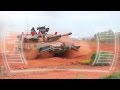
Test-fired of T-14 Armata next-generation battle tanks at the Staratel test range in Nizhny Tagil.
nextbigfuture
Russia is in talks with India to upgrade nearly 1000 T-90 tanks.
Russia could develop more extensive upgrades for their own older tanks.
The Armata tank is equipped with the Afganit active protection
system, which uses a combination of sensors and kinetic energy
projectiles to knock down incoming rocket propelled grenades, antitank
missiles, and subcaliber projectiles. The tank also features an
anti-detection aerosol disperser, a new explosive reactive armor
nicknamed “Malachite,” slat armor covering the engine spaces and even an
electronic countermine system to prevent antitank mines from
detonating.
Those sensors and weapons systems and the laser guided missiles could be placed onto older tanks.
Some Armata innovations would not be transferrable to older tanks.
Armata armor is a composite incorporating a new steel alloy known as
44C-SV-W, developed by the JSC Institute of Steel—also known as the NII
Stali Institute for Protection—in Moscow. The new steel, made via
electroslag melting, is apparently lighter than traditional steel,
shaving “hundreds of kilograms” off the vehicle weight.
The
USA M1 Abrams’ M256 120-millimeter smoothbore gun has a maximum
effective range between 3 km (1.86 miles) and 4 km (2.48 miles).
In
military parlance, the Armata could very well “out-stick” the M1 by a
factor of three, comfortably destroying American tanks before the latter
can get within engagement range.
In real-world war situations, though, there are rarely situations
where two objects at ground level are visible to one another at seven
and a half miles. Hedges, trees, buildings, elevation changes, and other
terrain features all conspire to block visibility at ground level.
Outside of the plains of Kansas, the Russian steppes, and the Sinai
desert, there are seldom places where two objects are visible at even
three or four miles.
Even if an Armata does manage to lock onto an Abrams at extreme
ranges, the American tank isn’t helpless. The Abrams’ armor, reinforced
with a layer of depleted uranium and now reactive armor, is widely
considered the best in the world. Reactive armor is particularly useful
against the shaped charge warhead on the Sprinter. Also, the Army is
planning to install active protection systems (APS) on the Abrams. An
APS upgrade would consist of outward-facing radar antennas scanning for
incoming threats in all directions. One detected, APS launches
interceptors to and detect and kill incoming rockets and missiles.
The
Armata is a new and innovative tank. USA analysts note that many of the
Armata’s advanced survivability features are drawn from the Israeli
Merkava series.
The Russian seem to have advanced the
state-of-the-art in terms of reactive armor and active protection. If
the Russian Afghanit active protection system works as advertised, the
Armata could prove to be a serious problem for the West if it were ever
produced in numbers. However, most Western analysts—government and
private sector—are dubious about Russian claims that their APS can
defeat kinetic energy rounds.
However, even if the Armata was as dangerous as the British report
claims, Russia is not likely to be able to afford the expensive new
machine in the huge quantities. Using the British reports own
numbers—120 Armata tanks produced per year.
nextbigfuture